
The Alaska Buyer's Journey
From start to finish, no fluff — your complete roadmap to buying a home in Alaska
Schedule a ConsultationBuying a home can feel overwhelming, especially if it's your first time. My goal as your Realtor is to make the process simple, clear, and as stress-free as possible.
Here is exactly how the home buying process works in Alaska, step by step, using the same system I walk all my clients through.
Get Financed First
Before we ever look at a single home, the very first step is getting pre-approved with a lender. This tells you how much home you can afford, what your monthly payment will look like, and which loan program fits you best.
My Preferred Local Lenders
I strongly recommend using local lenders instead of big national banks or credit unions. Communication and speed matter in real estate — especially in competitive situations.
Some of the lenders I trust most:
- First Rate Financial — Kristen Brown (assistant Ashley Milan)
- First Rate Financial — Josh Herr
- First Rate Financial — Slavic Lund
Why I Prefer First Rate Financial
First Rate Financial is my top recommendation because:
- They do underwriting up front — your approval is solid, not just a preliminary estimate
- Their communication is excellent — responsive when timing matters
- They stand behind their approvals — and they're local and well known
- They guarantee up to $5,000 of your earnest money if something goes wrong on their end
That reputation matters. When sellers see a pre-approval from First Rate Financial, it carries weight. In multiple-offer situations, a strong local lender can be the difference between winning and losing a house.
Why Local Lenders Win Deals
Listing agents recognize reputable local lender names and take those offers more seriously. A local lender who does upfront underwriting signals that the buyer's financing is solid — not just a preliminary estimate that might fall apart during processing. That confidence gives your offer an edge over competing buyers using unknown or out-of-state lenders.
Why I Avoid Credit Unions
In my experience:
- Their fees tend to be higher
- Communication is often poor
- Closings get delayed more frequently
If you want smooth, fast, and reliable — local lenders are the way to go.
Credit Considerations
Your lender will also let you know if you need to work on your credit score before purchasing. If credit repair is needed, they can advise on the steps to take — and you'll have a clear timeline for when you'll be mortgage-ready. It's never too early to have this conversation.
Let's Go Look at Homes
Once you're pre-approved, we start touring homes. A few things most buyers don't realize:
- Many people find "the one" within the first 1-2 showings — you can eliminate a lot of homes just from photos and maps
- Location matters more than anything — you can change a kitchen, you can't change a commute
- VA and FHA loans are stricter — homes must meet health and safety standards
- Most foreclosures are cash-only and usually won't qualify for VA or FHA
- You'll be taking your shoes off at most showings — wear easy slip-ons
Do Your Homework Before Showings
Before we schedule tours:
- Drive by the property
- Check Google Maps and satellite view
- Look at the neighborhood
- Make sure the location truly works for you
I can't tell you how many times buyers say "that's too far" or "I didn't realize there was a junkyard nearby" after we've already driven there. A little research up front saves everyone time.
Showing Etiquette
Always assume the home has cameras. Don't criticize the home out loud, don't discuss offer strategy inside the house, and be respectful of personal photos and belongings. You don't want to give the seller any leverage.
Found the Right House? Don't Wait
If a home checks all your boxes and fits your budget — don't hesitate.
Too many buyers think they need to see more homes "just to be sure," and then they lose the one they loved to another buyer.
If it feels right, it usually is.
Why Hesitation Costs You
In Alaska's market, well-priced homes in popular areas can receive offers within days. Every day you wait to "think about it" is a day another buyer could submit an offer. If the home meets your criteria, fits your budget, and you can see yourself living there — that's a strong signal to move forward.
Submitting an Offer
To submit an offer, you must have one of the following:
- A pre-approval letter from your lender
- Proof of funds if you are paying cash
Without proof of funds or a pre-approval, an offer is basically worthless.
Cash Buyers — Important to Know
- If your cash is tied up in stocks, investments, or retirement accounts, it can take 3-5 business days (and sometimes up to 7-14 days) to liquidate funds
- That timing matters when making offers — plan ahead so you can move quickly when needed
Negotiating the Deal
Negotiations depend heavily on Days on Market (DOM).
How Days on Market Affects Offers
- 0-5 days on market: Don't expect discounts or large closing cost requests
- 3-4 weeks on market: More room to negotiate — better chance to ask for extras
- 60-100+ days on market: Best leverage for buyers
In Alaska, average days on market runs around 100 days in winter and approximately 70 days in summer. Lowball offers rarely work unless the home has been sitting for a long time.
Closing Cost Negotiations
I've negotiated up to $10,000 in seller-paid closing costs, but every deal is different.
If you need $8,000 in closing costs and the seller only agrees to $4,000, we can sometimes increase the purchase price slightly and have the seller credit the difference.
The Key to Negotiations
It's not about winning. It's about finding a middle ground that works for both sides. Sellers who feel respected are more likely to make concessions. Aggressive tactics often backfire — especially in Alaska's smaller market where agents and sellers talk.
Earnest Money
Once your offer is accepted, you have 3 business days to submit earnest money.
Typical earnest money is about 1% of the purchase price and is paid by cashier's check or bank wire.
This money is YOUR money. It can be used toward your down payment, closing costs, or refunded at closing (common with VA loans).
When Could You Lose Earnest Money?
Very rarely. You can back out and keep your earnest money if:
- The home inspection reveals major issues
- The seller refuses to do required repairs
- Septic fails and the seller won't fix it
- The appraisal comes in low and the seller won't renegotiate
- Financing falls through
The only time you lose earnest money is if you back out for no contractual reason after contingencies are removed.
Due Diligence (Usually 2-3 Weeks)
This is one of the most important phases. During this time, we:
- Order inspections
- Review title
- Negotiate repairs
- Review HOA documents (if applicable)
- Make sure the home is what it should be
Home Inspection
I highly recommend Biff's Professional Home Inspections. Biff and his assistant Advance are fantastic — decades of experience, extremely thorough, and a great reputation.
Typical Inspection Costs
- Standard home: approximately $500
- Larger homes (over 2,500 sq ft): approximately $600
- Outlying areas (Willow, etc.) may add a small travel fee
Inspections usually take a few hours, and you're encouraged to attend so you can learn about the home firsthand.
Why Inspections Protect You
A $500 inspection can reveal tens of thousands in hidden problems. If significant issues are found, we can negotiate repairs, a price reduction, or you can walk away with your deposit intact. This contingency exists specifically to protect buyers from costly surprises.
Even AS-IS Properties
Even if a home is sold as-is, I still recommend an inspection for your peace of mind. You want to know what you're buying — an inspection helps you budget for future repairs even if the seller won't make them now.
Repair Requests
I keep repair negotiations simple: I only ask for health and safety repairs.
Sellers generally will not do cosmetic fixes, minor upgrades, or normal wear and tear.
Most common repair items include:
- Smoke and CO detectors
- GFCI outlets
- Deck safety issues
- Handrails
The average inspection produces about 13 health and safety items — that's normal.
The Appraisal
Here's something many buyers don't know: the buyer pays for the appraisal up front.
- Cost is typically $950-$1,100, usually around $1,000
- About 95% of the time, the seller reimburses the appraisal cost at closing as a credit
What If the Appraisal Comes in Low?
Example: purchase price is $320,000 but the appraised value is $300,000.
Your options:
- Ask the seller to lower the price
- Bring extra cash to cover the difference
- Walk away and keep your earnest money
You typically have 48 hours to decide.
Why Appraisals Exist
The lender needs to verify that the home's value supports the loan amount. If the appraisal comes in lower than the purchase price, the lender won't finance the full amount — because they'd be lending more than the home is worth. This protects both the lender and you as the buyer from overpaying.
The Waiting Phase
This is where buyers feel like nothing is happening. Behind the scenes, we are waiting on the appraisal, waiting on repairs, and waiting on underwriting. This is totally normal.
Most Alaska closings take 33-45 days from contract to closing.
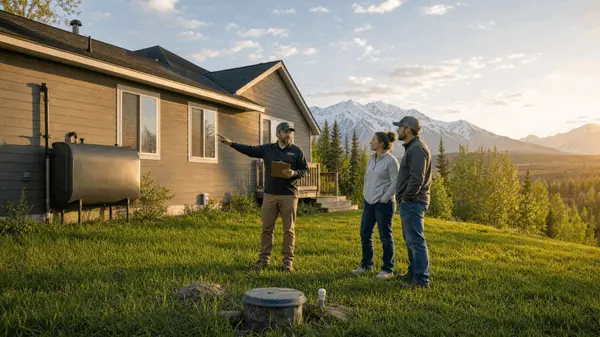
Septic and Well Testing (Very Common in Alaska)
VA and FHA Requirements
- Septic must be inspected within 90 days of closing and must pass — if it fails, it must be repaired before closing
- Water tests for VA loans require specific testing for nitrate, nitrite, lead, and coliform
- Sellers normally pay for these tests
Anchorage Is Different
- Many homes in Anchorage are on public water and sewer — no septic test required
- The closing process is simpler when these tests aren't needed
- Eagle River and Chugiak homes may vary — some are on wells, some on municipal water
Repairs and Final Touches
During this phase, we wait for:
- Repairs to be completed
- Invoices from contractors
- Re-inspections if needed
I track all of this so nothing falls through the cracks.
Final Walkthrough
Before closing, we'll do a final walkthrough to confirm repairs were completed and the home is in expected condition. This is your last chance to identify issues before taking ownership.
Utilities Tip
Take a photo of the electrical meter number during the walkthrough — you'll need it to transfer utilities. Set up gas and electric before recording day so you're not without heat (critical in Alaska winters).
Closing Day — Alaska Is Unique
Alaska's closing process works differently than most states. Here's what to expect:
- You sign documents the business day before recording
- Recording happens the next business day
- Keys are released AFTER recording
Example: Sign Friday → Record Monday → Keys Monday
Why Keys Aren't Released at Signing
In Alaska, the title company must wait for funds to clear and the title to be officially recorded with the state. This means if you sign on Friday, recording happens Monday, and you get your keys Monday. Plan your moving schedule accordingly.
What to Bring
- Valid government-issued ID
- Power of Attorney if applicable
Title Company
Most buyers don't have a preference, so I typically use First American Title — Natasha Crothers and Team. But you always have the right to choose your own title company and inspector.
Once recording is complete — congratulations, you're a homeowner!
Frequently Asked Questions
What is the first step to buying a home in Alaska?
Get pre-approved with a lender before looking at homes. This tells you how much you can afford, what your monthly payment will look like, and which loan program fits you best. I recommend local lenders like First Rate Financial for faster communication and stronger approvals.
How long does it take to close on a home in Alaska?
Most Alaska closings take 33 to 45 days from accepted offer to closing. The timeline depends on loan type, lender speed, appraisal scheduling, inspection negotiations, and title or escrow workload. Alaska also requires a separate recording day after signing.
How much earnest money do I need in Alaska?
Typical earnest money is about 1% of the purchase price, paid by cashier's check or bank wire within 3 business days of offer acceptance. This money is yours and can go toward your down payment, closing costs, or be refunded at closing.
What is septic and well testing and do I need it?
Many Alaska homes outside Anchorage are on private septic and well systems. VA and FHA loans require septic inspection within 90 days of closing and specific water testing for nitrate, nitrite, lead, and coliform. Sellers normally pay for these tests. Homes in Anchorage on public water and sewer typically do not require this testing.
How much does a home inspection cost in Alaska?
A standard home inspection costs approximately $500, with larger homes over 2,500 square feet running around $600. Outlying areas like Willow may add a small travel fee. Inspections typically take a few hours and buyers are encouraged to attend.
How does closing work in Alaska?
Alaska closing works differently than most states. You sign documents the business day before recording. Recording happens the next business day. Keys are released after recording, not at signing. For example, if you sign on Friday, recording happens Monday, and you get your keys Monday.
My Commitment to You
Your Interests First
I work for you, not the sale. My job is to help you make the right decision — even if that means advising against a particular property.
Clear Communication
I explain every step thoroughly and answer all your questions patiently. You'll never feel rushed or pressured — and you'll never sign anything you don't understand.
Nothing Falls Through the Cracks
From inspections to septic tests to underwriting — I track every detail so the process stays on schedule and nothing gets missed.
Alaska Expertise
I live and work in Alaska. I understand the unique considerations — from winter access and heating systems to septic requirements and seasonal market patterns.
Ready to Start Your Alaska Home Buying Journey?
Whether you're months away or ready to begin today, I'm here to answer your questions and guide you through every step.
Real Estate News & Resources

REVIEWS

Shadowelite4ever


sara ellington

Walter Zimmerman